
PATENT PROSECUTION
GUIDEBOOK in Japan
INTRODUCTION
This guidebook is intended primarily for patent practitioners outside Japan. Its purpose is to provide an overview of the procedures for obtaining a patent right in Japan, together with practical tips for navigating Japanese patent prosecution.
Some aspects of Japanese patent practice are based on principles that are familiar to practitioners in other jurisdictions, including the United States and Europe. For example, the roles of the specification and claims are broadly similar across major patent systems. Amendments made during prosecution must generally be supported by the disclosure as originally filed, and the scope of patent protection is determined primarily by the claims.
At the same time, Japanese patent practice includes a number of procedural features that may differ from those of other jurisdictions. For example, the Japan Patent Office distinguishes between a First Notice of Reasons for Refusal and a Final Notice of Reasons for Refusal. Different requirements apply to amendments depending on which notice has been issued.
This guidebook explains the basic framework of patent prosecution in Japan, from filing through grant and appeal procedures. In addition, the "Practice Tip" sections highlight practical considerations that may be useful for patent practitioners and in-house IP professionals handling Japanese patent applications.
We hope that this guidebook will serve as a useful reference for practitioners seeking to obtain patent rights in Japan.
Chapter 1 Filing a Patent Application
1.1 Filing Routes for Patent Applications
A patent right in Japan is established through the filing of a patent application with the Japan Patent Office (JPO), followed by examination and registration.
Foreign applicants may seek patent protection in Japan through one of the following routes:
- PCT Route
- Paris Convention Route
- Direct Filing
(1) PCT Route
An international application filed under the Patent Cooperation Treaty (PCT) is accorded an international filing date by the receiving Office. For the purposes of the Patent Act, the international application is deemed to be a patent application filed in Japan on the international filing date. Such a deemed application is referred to as an "international patent application."
To obtain a patent right in Japan, however, the applicant must complete the procedures for entering the Japanese national phase of the international patent application within the prescribed time limit. Failure to complete the national phase entry procedures within the prescribed period results in the international patent application being deemed withdrawn in Japan, and a patent right can no longer be obtained.
(2) Paris Convention Route
A national of a member country of the Paris Convention may file a patent application in Japan claiming priority to an earlier application filed in another member country within the applicable priority period. A patent application claiming Paris Convention priority may benefit from the filing date of the earlier application for certain purposes, such as the assessment of novelty and inventive step.
Although Taiwan is not a member of the Paris Convention, the Patent Act permits an applicant to claim priority in Japan based on an earlier patent application filed in Taiwan.
(3) Direct Filing
A foreign applicant may also file a patent application directly with the JPO without using the PCT system and without claiming Paris Convention priority.
1.2 PCT Route
(1) National Phase Entry Deadline
To obtain a patent right in Japan based on an international patent application, the applicant must complete the Japanese national phase entry procedures within 30 months from the priority date. For this purpose, the priority date means the filing date of the application on which the priority claim is based if the international application claims priority. If the international application does not claim priority, the priority date means the international filing date.
For an international patent application filed in a foreign language, the applicant must submit Japanese translations of the application documents within the above time limit.
However, if a National Document containing only bibliographic information is filed during the period from 28 months to 30 months from the priority date, the Japanese translations may be submitted within two months from the filing date of the National Document. As a practical matter, this procedure may extend the deadline for submitting the Japanese translations by up to two months.
(2) Restoration after Missing the Deadline
If the applicant fails to complete the national phase entry procedures within 30 months from the priority date, the application may still be restored if the failure was unintentional. In such a case, the applicant must complete the national phase entry procedures within two months from the date on which the applicant became able to do so, and no later than one year after the expiration of the 30-month time limit. In practice, the date on which the applicant became able to do so will generally be the date on which the applicant became aware that the deadline had been missed.
To request restoration, the applicant must file a statement explaining the reasons for the failure to complete the national phase entry procedures and pay the prescribed restoration fee.
(3) Documents Required for National Phase Entry
a) Required Documents
National phase entry of an international patent application filed in a foreign language is completed by filing the following documents with the JPO:
- National Document
- Japanese translation of the specification
- Japanese translation of the claims
- Japanese translation of the abstract
- Japanese translation of the drawings
b) National Document
The National Document contains bibliographic information such as the international application number, the inventor(s), and the applicant(s).
If the applicant has previously filed a patent, utility model, design, or trademark application with the JPO, the applicant will have been assigned an Applicant Identification Number. An Applicant Identification Number is a number assigned by the JPO to identify the applicant. In such a case, the Applicant Identification Number should be included in the National Document.
c) Japanese Translations
For an international patent application filed in a foreign language, Japanese translations of the specification, claims, abstract, and drawings must be submitted. The Japanese translations must not contain matter extending beyond the content of the international application as originally filed.
d) Article 19 and Article 34 Amendments
If amendments under Article 19 or Article 34 of the PCT were made during the international phase, Japanese translations of the amendments may be submitted. If translations of the amendments are not submitted, the amendments will be deemed not to have been made for the purposes of the Japanese national phase.

- If you do not know the Applicant Identification Number, please provide us with the applicant's name and address. We can usually confirm the number on your behalf.
- When an applicant files an application with the JPO for the first time, the JPO issues a notification of the Applicant Identification Number. Since this number must be used in subsequent patent, utility model, design, and trademark applications filed with the JPO, we recommend retaining the notification for future reference.
- We can assist with the preparation of Japanese translations of the application documents. Please let us know whether you would like us to prepare the translations or whether you will provide your own translations.
- Upon request, we can review and revise the claims and specification to better align with Japanese patent practice before national phase entry.
1.3 Paris Convention Route
(1) Filing Deadline
A patent application claiming Paris Convention priority must be filed within 12 months from the priority date.
The applicant must file application documents in Japanese within the 12-month priority period.
Alternatively, the applicant may file the application documents in a foreign language within the 12-month priority period. This procedure is referred to as a Foreign-Language Application. The original language of the application documents is not limited to English and may be any language. Accordingly, application documents filed with a foreign patent office may be filed with the JPO without translation.
If a Foreign-Language Application is filed, Japanese translations of the application documents must be submitted within 16 months from the priority date.
If the translations are not submitted within 16 months from the priority date, the JPO will issue a notification to that effect. The applicant may still submit the translations within two months from the date of the notification. As a practical matter, this procedure may extend the deadline for submitting the translations by up to six months.
(2) Restoration after Missing the Deadline
If the applicant fails to file the application within the 12-month priority period, the application may still be filed if the failure was unintentional. In such a case, the application must be filed within two months from the expiration of the 12-month priority period.
To request restoration, the applicant must file a statement explaining the reasons for the failure to file the application and pay the prescribed restoration fee.
(3) Application Documents
a) Required Documents
A patent application claiming Paris Convention priority is filed by submitting the following documents to the JPO:
- Request
- Specification
- Claims
- Abstract
- Drawings
b) Request
The Request contains bibliographic information such as the inventor(s), the applicant(s), and the application number of the priority application.
If the applicant has previously filed a patent, utility model, design, or trademark application with the JPO, the applicant will have been assigned an Applicant Identification Number. In such a case, the Applicant Identification Number should be included in the Request.
c) Content of the Application Documents
Unlike the PCT Route, the application documents filed with the JPO may contain matter that was not included in the priority application.
d) Foreign-Language Applications
Instead of filing application documents in Japanese within the 12-month priority period, the applicant may file the application documents in a foreign language within the same period. This procedure is referred to as a Foreign-Language Application.
If a Foreign-Language Application is filed, Japanese translations of the application documents must subsequently be submitted.
If application documents are filed only in Japanese, correction of translation errors is not available because there is no foreign-language text on which to base the correction. By contrast, if a Foreign-Language Application is filed, translation errors may be corrected based on the originally filed foreign-language application documents. For this reason, filing a Foreign-Language Application is generally recommended where translation issues may become a concern.
1.4 Restriction on Multi-Multi Claims
In Japan, multiple dependent claims are permitted, but so-called "multi-multi claims" are not permitted. A multiple dependent claim is a claim that refers to more than one other claim in the alternative. A "multi-multi claim" is a multiple dependent claim that depends from another multiple dependent claim.
If the claims include a multi-multi claim, the JPO will issue a Notice of Reasons for Refusal. The multi-multi claim will not be examined for novelty, inventive step, or other patentability requirements until the improper claim dependency has been corrected.
The applicant may amend the claims to remove the improper multi-multi dependency in response to the Notice of Reasons for Refusal. However, if other grounds for refusal, such as lack of novelty or inventive step, are identified during the subsequent examination, a Final Notice of Reasons for Refusal will be issued. As explained later in this guidebook, amendments are subject to additional restrictions after a Final Notice of Reasons for Refusal has been issued.
- We strongly recommend removing any improper multi-multi dependencies before examination begins. For international patent applications, any improper multi-multi dependencies should be removed at the time of national phase entry or, at the latest, when requesting examination. For applications filed via the Paris Convention Route, the claims should preferably be drafted so that no multi-multi claims are included at the time of filing.
- Upon request, we can prepare claim amendments to remove improper multi-multi dependencies. We can also review and revise the application documents to better align with Japanese patent practice.
1.5 Other Important Considerations
(1) Power of Attorney and Assignment Documents
The JPO generally requires a Power of Attorney only when the applicant performs an act that may be disadvantageous to the applicant, such as withdrawing an application. Accordingly, a Power of Attorney is not required when filing a patent application.
Similarly, except in limited circumstances such as the recordation of an assignment of a patent right, the JPO generally does not require the submission of assignment documents. Therefore, in many cases, both a Power of Attorney and assignment documents may be omitted.
There are two types of Power of Attorney: an Individual Power of Attorney and a General Power of Attorney. In either case, a signature or seal is not required, and an electronic copy is sufficient.
(2) Patent Annuities
No patent annuities are payable before a patent right is registered. To maintain a patent right after registration, patent annuities must be paid to the JPO.
(3) Grace Period
a) General
If an invention loses novelty either (i) against the will of the person having the right to obtain a patent, or (ii) as a result of an act of the person having the right to obtain a patent, the loss of novelty may be disregarded if a patent application is filed within one year from the date on which the invention lost novelty.
b) PCT Route
For an international patent application, the international filing date must be within one year from the date on which the invention lost novelty.
In a case falling under item (ii) above, the applicant must submit a statement requesting application of the grace period and supporting evidence of the disclosure within 30 days after completion of the national phase entry procedure.
c) Paris Convention Route
For a patent application claiming Paris Convention priority, the filing date in Japan must be within one year from the date on which the invention lost novelty.
In a case falling under item (ii) above, the applicant must indicate, in the Request filed with the application, that application of the grace period is requested. Supporting evidence of the disclosure must be submitted within 30 days from the filing date.
Chapter 2 From Filing to Grant
2.1 Overview of the Patent Prosecution Process
The overall patent prosecution process in Japan is shown in Figure 1.
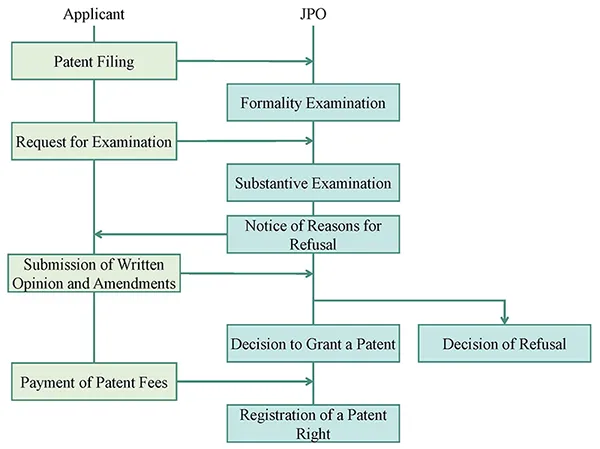
Figure 1. Overview of the Patent Prosecution Process
2.2 Request for Examination
In Japan, a patent application is not substantively examined merely because it has been filed. A request for examination must be filed within three years from the filing date of the application. For an international patent application, the filing date means the international filing date. For a patent application claiming Paris Convention priority, the filing date means the filing date in Japan.
If no request for examination is filed within the prescribed period, the application is deemed withdrawn and a patent right can no longer be obtained.
On average, the first examination result, either a Notice of Reasons for Refusal or a Decision to Grant a Patent, is issued approximately ten months after the request for examination is filed.
2.3 Notice of Reasons for Refusal
If, as a result of substantive examination, the examiner identifies one or more grounds for refusal, the JPO issues a Notice of Reasons for Refusal. The applicant may respond by filing a Written Opinion and/or amendments.
There are two types of Notices of Reasons for Refusal: a First Notice of Reasons for Refusal and a Final Notice of Reasons for Refusal. The initial Notice of Reasons for Refusal issued in an application is designated as a First Notice of Reasons for Refusal.
In either case, if the applicant successfully overcomes all of the notified grounds for refusal and no new grounds for refusal are identified, a Decision to Grant a Patent will be issued.
If the notified grounds for refusal are not overcome, a Decision of Refusal will be issued.
If the notified grounds for refusal are overcome but the examiner identifies additional grounds for refusal, a further Notice of Reasons for Refusal will be issued. Where the newly notified grounds for refusal arise solely as a result of amendments made in response to the previous Notice of Reasons for Refusal, the further notice will be a Final Notice of Reasons for Refusal. In other cases, the further notice will be a First Notice of Reasons for Refusal.
The distinction between a First Notice of Reasons for Refusal and a Final Notice of Reasons for Refusal is important because different amendment requirements apply, as discussed in Chapter 4.
Although Notices of Reasons for Refusal are often issued twice, a second notice is not guaranteed. If the grounds for refusal identified in the First Notice of Reasons for Refusal are not successfully overcome, the examiner may proceed directly to a Decision of Refusal without issuing a further Notice of Reasons for Refusal. Accordingly, applicants should not assume that they will have two opportunities to respond during examination. It is important to present the strongest possible arguments and amendments when responding to a Notice of Reasons for Refusal.
2.4 Decision to Grant a Patent
If, as a result of substantive examination, the examiner finds no grounds for refusal, a Decision to Grant a Patent will be issued.
A patent right is registered upon payment of the patent annuities for the first through third years. The payment must be made within 30 days from the date of the Decision to Grant a Patent. This period may be extended by an additional 30 days. If the required annuities are not paid within the prescribed period, the patent right will not be registered.
Once the patent right is registered, the JPO issues a patent certificate in electronic form to the patentee. The granted patent is also published in the Patent Gazette.
The term of a patent right is 20 years from the filing date of the application. To maintain the patent right, the patent annuities for the fourth and subsequent years must be paid within the prescribed time limits.
2.5 Decision of Refusal
As a result of examination, the JPO may issue a Decision of Refusal.
If the applicant disagrees with the Decision of Refusal, the applicant may file an Appeal against a Decision of Refusal. During examination, the application is examined by an examiner of the JPO. During the appeal proceedings, the case is reviewed by administrative patent judges of the JPO.
If the Appeal Board determines that no grounds for refusal exist, a Trial Decision to Grant a Patent will be issued. If the Appeal Board determines that the application should be refused, a Trial Decision of Refusal will be issued.
If the applicant disagrees with a Trial Decision of Refusal, the applicant may file an action for rescission of the Trial Decision with the Intellectual Property High Court.
Chapter 3 Requirements for Patentability
3.1 Requirements for Patentability
To obtain a patent right in Japan, a patent application must satisfy the requirements for patentability. During examination, the JPO determines whether the application satisfies these requirements. If one or more requirements are not satisfied, a Notice of Reasons for Refusal or a Decision of Refusal may be issued.
The principal requirements for patentability include:
- Novelty
- Inventive Step
- Enablement Requirement
- Support Requirement
- Clarity Requirement
Among these requirements, inventive step is often one of the most important issues in examination and is discussed in more detail below.
3.2 How Inventive Step Is Assessed
Lack of inventive step is probably the most frequently cited ground for refusal in Japan. The approach used by the JPO differs somewhat from both the Teaching-Suggestion-Motivation (TSM) test traditionally associated with U.S. practice and the Problem-Solution Approach used by the EPO.
(1) Framework for Assessing Inventive Step
In Japan, inventive step is assessed by determining whether a person skilled in the art could have easily arrived at the claimed invention based on the prior art. As shown in Figure 2, this assessment can be divided into four principal steps.
First, the claimed invention is identified based on the language of the claims. In principle, the invention is determined according to the matters recited in the claims.
Second, the inventions disclosed in the prior-art references are identified. These are typically categorized as a primary cited invention and one or more secondary cited inventions.
Third, the claimed invention is compared with the primary cited invention, and the similarities and differences are identified.
Fourth, the examiner considers whether a person skilled in the art could have easily arrived at the claimed invention, for example, by applying a secondary cited invention to the primary cited invention.
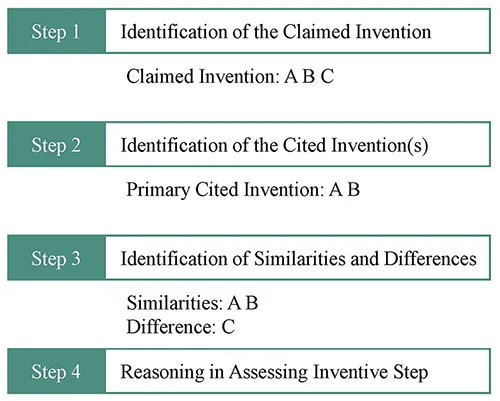
Figure 2. Framework for Assessing Inventive Step
(2) Reasoning in Assessing Inventive Step
In Step 4, the examiner evaluates whether a person skilled in the art could have easily arrived at the claimed invention. This assessment is made by considering both factors that support a finding of lack of inventive step and factors that support a finding of inventive step.
The principal factors supporting a finding of lack of inventive step include:
- Motivation for Applying Secondary Prior Art to Primary Prior Art
- Design Variation of Primary Prior Art
- Mere Aggregation of Prior Art
The principal factors supporting a finding of inventive step include:
- Advantageous Effects
- Obstructive Factors
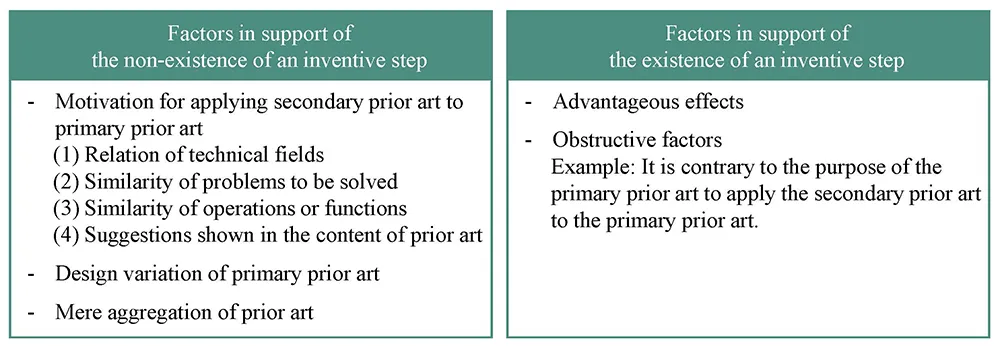
Figure 3. Main Factors for Reasoning
(3) Responding to a Lack of Inventive Step Rejection
When a Notice of Reasons for Refusal based on lack of inventive step is issued, it is important to analyze the examiner's reasoning in light of the four-step framework described above and the factors considered in assessing inventive step.
For example, the claims may be amended to clarify the differences between the claimed invention and the cited invention(s). If the examiner's identification of the cited invention is incorrect or unreasonable, the applicant may challenge that interpretation in a Written Opinion. The applicant may also argue that there is no motivation to apply the secondary cited invention to the primary cited invention, or that obstructive factors would have discouraged a person skilled in the art from making the proposed combination.
Upon request, we can analyze the examiner's reasoning, identify potential weaknesses in the rejection, and propose an appropriate response strategy, including amendments and arguments.
Chapter 4 Responding to Office Actions
4.1 Response Deadlines
When an applicant who does not have an address or residence in Japan receives a Notice of Reasons for Refusal, the response deadline is three months from the mailing date of the notice.
This response period may be extended by two months upon a first request for extension and by an additional one month upon a second request for extension, for a maximum extension of three months.
4.2 Written Opinion
By filing a Written Opinion, the applicant may present arguments against the reasons for refusal raised by the examiner and explain why the application satisfies the requirements for patentability.
4.3 Amendments
(1) Amendments
The claims, specification, and drawings may be amended.
For example, when a Notice of Reasons for Refusal based on lack of inventive step is issued, the claims may be amended to clarify the differences between the claimed invention and the cited invention(s). Amendments may also be made to the claims or the specification in order to overcome deficiencies relating to disclosure requirements, such as the enablement requirement, support requirement, or clarity requirement.
(2) Periods During Which Amendments May Be Filed
Amendments may not be filed at any time while a patent application is pending. As shown in Figure 4, amendments may be filed only during one of the following periods:
- From the filing of the application until issuance of the initial examination result*
- During the response period for a Notice of Reasons for Refusal
- Simultaneously with the filing of an Appeal against a Decision of Refusal
* In the case of an international patent application filed in a foreign language, amendments may be filed only after submission of the National Document and the Japanese translations of the application documents.
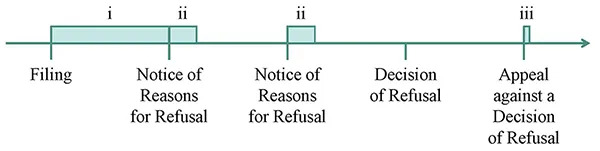
Figure 4. Periods During Which Amendments May Be Filed
(3) Restrictions on Amendments
The restrictions applicable to amendments vary depending on when the amendment is filed. In particular, different restrictions apply depending on whether the notice is a First Notice of Reasons for Refusal or a Final Notice of Reasons for Refusal.
a) Before Issuance of the Initial Examination Result
Before issuance of the initial examination result (i.e., a Notice of Reasons for Refusal or a Decision to Grant a Patent), amendments may be made provided that they do not introduce new matter.
b) During the Response Period for a First Notice of Reasons for Refusal
Amendments filed during the response period for a First Notice of Reasons for Refusal are subject to the following requirements:
- The amendment must not introduce new matter.
- The amendment must not change the special technical features of the invention.
c) During the Response Period for a Final Notice of Reasons for Refusal and upon Filing an Appeal against a Decision of Refusal
Amendments filed during the response period for a Final Notice of Reasons for Refusal, or simultaneously with the filing of an Appeal against a Decision of Refusal, are subject to the following requirements:
- The amendment must not introduce new matter.
- The amendment must not change the special technical features of the invention.
- Any amendment to the claims must be made for one of the following purposes:
- Deletion of claims
- Restriction of the scope of claims*
- Correction of errors
- Clarification of ambiguous statements
* To qualify as a restriction of the scope of claims under item b., the amendment must, for example, involve the addition of claim limitations, deletion of alternatives from a Markush-type expression, replacement of a generic concept with a more specific concept, or reduction in the number of claims referred to by a multiple dependent claim. In addition, the industrial field of use and the problem to be solved by the invention must remain the same before and after the amendment. Where the purpose of the amendment is restriction of the scope of claims under item b., the invention defined by the amended claims must be independently patentable.
Before filing a Written Opinion and/or amendments, it may be beneficial to conduct an interview with the examiner and take the examiner's preliminary views into account when preparing the response. Examiner interviews may be conducted in person, by telephone, or by web conference. Upon request, we can arrange and attend examiner interviews on behalf of our clients.
4.4 Correction of Translation Errors
In the case of an international patent application, if the Japanese translation of the application documents contains translation errors, such errors may be corrected on the basis of the corresponding foreign-language application documents as originally filed in the PCT international phase.
Where a patent application claiming Paris Convention priority is filed using only Japanese-language application documents, translation errors cannot be corrected on the basis of the priority application.
However, where a Foreign-Language Application is filed and Japanese translations of those documents are subsequently submitted, translation errors in the Japanese translations may be corrected on the basis of the originally filed foreign-language application documents.
4.5 Divisional Applications
(1) Divisional Applications
A divisional application is a new patent application filed by extracting part of a patent application that includes multiple inventions.
An applicant may divide an original patent application (parent application) to file a new patent application (child application). The applicant may also divide the child application to file a further patent application (grandchild application). The parent application, child application, and grandchild application may coexist, and each application may be examined separately and may result in a separate patent right.
When a Notice of Reasons for Refusal based on lack of unity of invention is issued, a divisional application may be filed to pursue protection for claims that have not been examined.
However, divisional applications are not limited to cases where a Notice of Reasons for Refusal based on lack of unity of invention has been issued. For example, if no grounds for refusal have been found for some claims but grounds for refusal have been found for other claims, the applicant may delete the rejected claims from the original application and file them in a divisional application. This strategy may allow the applicant to obtain early protection for the allowable claims while preserving an opportunity to pursue protection for the rejected claims.
Even after a Decision to Grant a Patent has been issued, a divisional application may be filed with a new set of claims drafted from a different perspective. This may allow the applicant to obtain broader or more multi-layered protection for the invention.
(2) Periods During Which Divisional Applications May Be Filed
Divisional applications may be filed only during one of the following periods:
- During any period in which amendments may be filed
- Within 30 days from the date of a Decision to Grant a Patent and before registration of the patent right
- Within the time limit for filing an Appeal against a Decision of Refusal
The Japanese Patent Act does not provide a procedure equivalent to a Request for Continued Examination (RCE) in the United States. However, divisional applications may be used as an alternative to an RCE.
Chapter 5 Appeal Procedures
5.1 Appeal against a Decision of Refusal
Some patent applications result in a Decision to Grant a Patent, while others result in a Decision of Refusal. In some cases, the applicant may disagree with the examiner's decision.
If the applicant is dissatisfied with a Decision of Refusal, the applicant may file an Appeal against a Decision of Refusal and request further review of the application.
An appeal is examined by a panel of three (or, in some cases, five) administrative patent judges. Compared with examination proceedings, appeal proceedings generally involve a more thorough review of the application by a panel.
The procedure for an Appeal against a Decision of Refusal is shown in Figure 5.
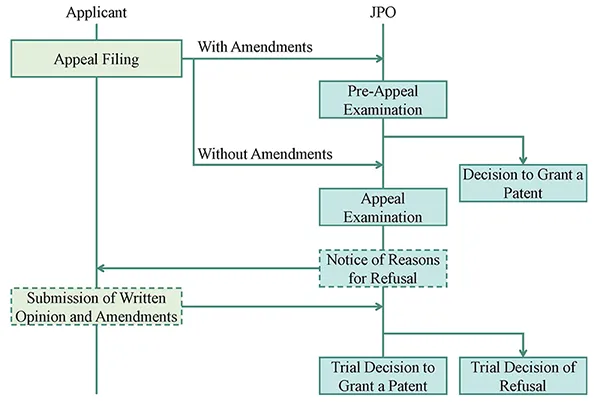
Figure 5. Procedure for an Appeal against a Decision of Refusal
5.2 Appeal Proceedings before the JPO
(1) Filing an Appeal
For an applicant who does not have an address or residence in Japan, an Appeal against a Decision of Refusal must be filed within four months from the date of service of the certified copy of the Decision of Refusal. This time limit cannot be extended.
The written request for an Appeal against a Decision of Refusal must explain in detail why the application should be granted a patent.
(2) Pre-Appeal Examination
Where amendments are filed simultaneously with an Appeal against a Decision of Refusal, a Pre-Appeal Examination is conducted. In a Pre-Appeal Examination, the examiner who issued the Decision of Refusal re-examines the patent application.
The examiner reconsiders whether any grounds for refusal exist in light of the amendments filed together with the appeal and the arguments presented in the written request for the appeal. If the examiner concludes that no grounds for refusal exist, a Decision to Grant a Patent will be issued.
If the examiner concludes that grounds for refusal still exist, the application is referred to a panel of administrative patent judges for appeal proceedings.
(3) Appeal Proceedings
The panel of administrative patent judges reviews both the grounds for the Decision of Refusal and the arguments presented in the appeal. If the panel concludes that the Decision of Refusal was improper, it examines whether any other grounds for refusal exist. If no other grounds for refusal are found, a Trial Decision to Grant a Patent will be issued.
If the panel concludes that there is no basis for overturning the Decision of Refusal, a Trial Decision of Refusal will be issued.
The period for filing an Appeal against a Decision of Refusal may be the last opportunity to file a divisional application. If the applicant wishes to preserve additional options for obtaining patent protection in the event that the appeal ultimately results in a Trial Decision of Refusal, a divisional application should be considered when the Decision of Refusal is issued.
5.3 Action for Rescission of a Trial Decision
In appeal proceedings before the JPO, either a Trial Decision to Grant a Patent or a Trial Decision of Refusal will be issued. If the applicant is dissatisfied with a Trial Decision of Refusal, the applicant may file an action with the Intellectual Property High Court seeking rescission of the Trial Decision.
(1) Time Limit for Filing an Action
For an applicant who does not have an address or residence in Japan, an action for rescission of a Trial Decision must be filed within 120 days from the date of service of the Trial Decision (a statutory period of 30 days plus an additional period of 90 days). This time limit cannot be extended.
(2) Proceedings before the Court
In an action for rescission of a Trial Decision, documents previously submitted to the JPO that are relevant to the grounds for rescission should be submitted to the Court as evidence.
The Court determines whether the Trial Decision is unlawful based on the arguments and evidence presented by the parties.
(3) Scope of Review
The issue in an action for rescission of a Trial Decision is whether the Trial Decision is unlawful. Both procedural errors and substantive errors in the Trial Decision may be reviewed.
The Court does not determine whether the application should be granted or refused. Rather, it determines whether the Trial Decision itself is legally sustainable.
(4) Judgment
If the Court finds the plaintiff's arguments well founded, the Trial Decision will be rescinded. If not, the Trial Decision will be maintained.
When a judgment rescinding the Trial Decision becomes final and binding, the JPO is bound by the Court's findings and must conduct further appeal proceedings in accordance with the judgment and issue a new Trial Decision.
As a result of the resumed appeal proceedings, the application may ultimately proceed to grant.
In Japan, court proceedings do not directly determine whether a patent should be granted. If the Intellectual Property High Court rescinds a Trial Decision of Refusal, the case is remanded to the JPO, which must conduct further appeal proceedings and issue a new Trial Decision.
If you have any questions regarding this guidebook or Japanese patent practice, please feel free to contact us.

Nihon Seimei-Takamatsu-Ekimae Bldg. 3F,
1-1-8, Kotobuki-cho, Takamatsu-shi, Kagawa
760-0023 JAPAN
TEL: +81-87-823-6812
FAX: +81-87-823-6814
E-mail:
URL:https://www.yamauchi-pat.com/en/
Disclaimer
The information contained in this guidebook is provided for general informational purposes only and should not be relied upon as legal advice. Readers should use this information at their own discretion and responsibility.
The contents of this guidebook do not create an attorney-client relationship between the reader and YAMAUCHI Patent Attorneys.
While every effort has been made to ensure the accuracy of the information contained herein, YAMAUCHI Patent Attorneys assumes no responsibility or liability for any loss, damage, or inconvenience arising from the use of this guidebook or reliance on its contents.
The contents of this guidebook are subject to change without notice.
Copyright © 2026 YAMAUCHI Patent Attorneys. All Rights Reserved.
CONTACT
Please feel free to contact us.
 +81-87-823-6812
 +81-87-823-6814